Because of various problems with Blogger, I've copied everything as of November 26, 2012 over to WordPress. The new location is Ask the Scientologist. I am not deleting this blog and will still accept comments and answer questions here too, but any new articles will appear at the WordPress location. I apologize if this causes any problems.

Friday, January 30, 2009

Scientology Thought Control - Part 3

We covered, in Scientology Thought Control - Part 1, how simple definitions can change the way that people think. In that example, the Hubbardisms entheta and theta cause Scientologists to reject "negative" information ("entheta") about the church even when true, and accept "positive" information ("theta") about the church even if false.

However, I don't want to give the impression that these are the only words and the only concept that inculcates the thought control ability in Scientologists. There are many, many Scientology words, phrases and concepts that work in that direction.

One of the most pervasive and powerful concepts for thought control is Hubbard's ideas about the "Overt-Motivator Sequence". This is, really, Hubbard's reworking of the idea of karma. The short version is: One first does something bad (an "overt") and subsequently, one "pulls in" (causes something to happen to oneself) something bad (a "motivator") as an after-the-fact excuse for the previous overt.

Get it? If anything bad happens to you, it's because you "pulled it in" -- because of your overts!

Understand that, in Scientology, this is an absolute. Anything bad that happens to you is your fault!

The engine falls off a jetliner and lands on you, it's totally your fault. How can that be? Well, it's probably because sometime, in some past life, you dropped a jet engine on someone else -- or something.

See? It's all your fault.

And one of the manifestations of having an overt is that you start complaining about what was done to you. The Scientological response to someone complaining about what was done to them is, "What did you do?"

This is one very important component in Scientology thought control.
Now, it must be noted here that this concept does not include David Miscavige or the Church of Scientology, nor did it ever include L. Ron Hubbard. If anything bad happens to Miscavige or Scientology, it is because they only do good -- and Evil People are attacking them. When Miscavige complains about all that has been done to him, it's because he is the only good person around. No overts there!
So, to get back to the rest of us, this means that you can never complain. If you're in deep debt from paying Scientology so much money -- it's completely your fault. If you didn't get the expected gains from Scientology -- it's your fault. If you ran your business strictly according to Hubbard and it failed -- it's totally your fault.

And here is a key point: Anything the Church of Scientology does to you is your fault! And you can never complain.

If the church, or Miscavige, does something harmful to you -- you "pulled it in".

Woe betide you if you dare complain or even hint that it's not right. Oh boy! If you did that, you'd be in serious trouble! "What did you do? It's your overts! It's all the bad things you've done!"

So Scientologists never complain. Further, to stay out of trouble, they will actually lie and say "I'm happy, everything is fine!"

Scientology thought control: It's all your fault, you are the criminal, so shut up and "be happy!"


So, for Scientologists, here is a little thought exercise: Why don't you apply the same criteria to Miscavige and the Church of Scientology that they impose on you.
  • Miscavige constantly complains about everyone else, what they've "done to him", what "crimes" they're committing against him, how bad everyone else is. His rants are famous. So ask: What are his crimes?
  • The Church of Scientology is collapsing. Governments are investigating and taking Scientology organizations to court. There are protests -- and they are not stopping. Lawsuits are being filed against the church. People are leaving and very few new people are coming in. Bad things are happening to the church all over the world. So ask: What did the church do to "pull it in"?
Hmmm?

I'm not saying this whole "Overt-Motivator" theory is absolutely correct, but if you believe it, then apply it to Miscavige and Scientology as well. What did they do?

Then find the answers. You will learn a lot.
-

Tuesday, January 13, 2009

Scientology and the Emperor's New Clothes

You are, undoubtedly, familiar with the fairy tale "The Emperor's New Clothes" by Hans Christian Anderson.

Plot summary from Wikipedia:
An emperor of a prosperous city who cares more about clothes than military pursuits or entertainment hires two swindlers who promise him the finest suit of clothes from the most beautiful cloth. This cloth, they tell him, is invisible to anyone who was either stupid or unfit for his position. The Emperor cannot see the (non-existent) cloth, but pretends that he can for fear of appearing stupid; his ministers do the same. When the swindlers report that the suit is finished, they dress him in mime. The Emperor then goes on a procession through the capital showing off his new "clothes". During the course of the procession, a small child cries out, "But he has nothing on!" The crowd realizes the child is telling the truth. The Emperor, however, holds his head high and continues the procession.
The point, of course, is that when people buy into some idée fixe that does not match reality, they inevitably have to choose: Deny reality or deny the fixed idea. What makes the story so odd and funny is that all the adults in the story chose to deny reality.

Scientologists will be familiar with this concept as Hubbard's "held-down seven". He compared the aberrated mind to a calculator with a stuck "7" key. No matter what you enter into that calculator, the results will be wrong, because "7" has been arbitrarily and automatically entered into every calculation.

So what does all this have to do with Scientology?

Scientologists have a very, very strong and inflexible idée fixe that alters and colors everything they see, everything they hear, everything they do. It is completely arbitrary, unproven and even uninspected, yet it is the foundation of all they believe in.

It is this:
L. Ron Hubbard created a technology that solves everything and always, always works perfectly.
There is, actually, no proof that this statement is true, but all Scientologists would agree, without hesitation, that this statement is absolute Truth.

Because reality doesn't conform to this statement, once this idée fixe has been accepted as absolute Truth, more assertions must be made and must become incorporated into a Scientologist's "reality".

If Scientology "always, always works perfectly", what do you do when it doesn't work? It can't be that Hubbard was wrong! It can't be that the technology was ineffective, or wrong! It must be someone else who is wrong. And so you get this:
If Scientology doesn't work, you haven't applied it correctly.
Ah! Now everything is OK! This is the ultimate excuse and the most amazing and perfect way to ensure that Scientology "always works perfectly".

If Scientology failed, well, by definition, it wasn't Scientology!

If Scientology succeeded, then it was Scientology!

It's the ultimate excuse for any failures in Scientology. No one can prove that Scientology works, no one can guarantee that Scientology works -- but they can redefine any failures as "not Scientology", and, well, that fixes it.

Almost.

You will still get a few people who will very carefully apply Scientology exactly as Hubbard said, and it still doesn't work. What to do? Scientology was applied exactly as Hubbard said, and the good results didn't occur!

Do we accept that Scientology is flawed? Nope! Here's what we do:
Scientology won't work on Evil People!
Perfect! If you don't get better from Scientology -- it's your fault! You are an Evil Person!

Ah! This is really nice! Now you can't complain if you don't see any results! To do so would be to confess that you are an Evil Person! Perfect!

Here is what happens: There are probably several tens of thousands of Scientologists out there, and each one of them didn't get the promised gains from Scientology. I'm not kidding here, not one single person got the promised gains from Scientology. They will inevitably claim they were "happier" after this action or "more certain" after that action, but it is absolutely true that none of them actually got the promised gains from Scientology.

Let me be very clear, here. Some people are confused about what I'm saying. I'm not saying they get no benefit, I'm saying that no one is getting what is specifically promised as abilities to be gained from each and every one of the Scientology levels. These abilities are explicitly promised by Scientology, but never delivered to anyone.

But Scientologists can't admit it! They think that every other Scientologist got the promised gains, and only they didn't. And, because they didn't get the "guaranteed" gains from Scientology, they believe they must be Evil! So they can't admit it. Since they can't talk about it, and they certainly can't tell anyone that they didn't get the gains, nobody in Scientology knows that this lack of results is universal.

No one is getting the promised gains from Scientology. They're all pretending they did and thinking that everyone else really did. And they are all hoping that the next Scientology level will be the one where they get the gains.

They are all wearing Hubbard's New Clothes! Each one is naked and pretending that their clothes are just as beautiful as the clothes every other Scientologist is pretending to wear.
-

Saturday, January 10, 2009

Scientology Thought Control - Part 2

As mentioned in Scientology Thought Control - Part 1, there are many ways that Scientology trains people to properly control their thoughts so that they can accept concepts and controls that, under normal circumstances, would be difficult to accept.

In that article, we saw how the concept of "entheta" allows Scientologists to reject "negative" information, even when true, and accept "positive" information without inspection.

While this is a start to good thought control, it really isn't enough.

The next part of training Scientologists to control their thoughts is embodied in L. Ron Hubbard's famous "Keeping Scientology Working" (KSW). This policy letter from Hubbard is the very first thing that every Scientologist must read and "duplicate" when they do any Scientology training.

Now, you must understand what that "and duplicate" phrase means in Scientology-speak. While the official Scientology definition is to "make a perfect copy", this isn't how it is applied when you're studying Scientology. To "duplicate" when studying Scientology means "completely agree with".

Let me explain. In Hubbard's Study Technology, the source material being studied is always assumed to be 100% correct and 100% workable. If the student doesn't understand the material or (gasp!) disagrees with the material, it is the student's fault, never the material's -- and once the student "handles their study difficulty" they will agree with the material being studied.

And the very first item on every course that a Scientologist takes is this "Keeping Scientology Working" issue.

And what does this policy letter say? In it, Hubbard modestly states that he has created an absolutely perfect and always workable technology for everything. No one helped him; everything anyone else has ever done is, from Hubbard's analysis, horrible and destructive; only Hubbard's solutions are good; if you apply Hubbard's technology and it doesn't work, it's your fault, you did something wrong; and (in my opinion the most clever assertion), it is the very evil people who disagree with Hubbard and his technology.

And all Scientologists, as the very first order of business, must completely agree with these concepts before they can get on with any other studying.

From that point on, the Scientologist's ability to control their thoughts in the proper Scientology manner is quite simple.

If Hubbard said it: It is true.

If evidence disagrees with what Hubbard said: The evidence is false.

If someone disagrees with Hubbard: They are evil.

If someone applies Hubbard's technology and nothing happens, or something bad happens: It's their fault, not Hubbard's.

If someone doesn't get wonderful results from Scientology: They are one of the Evil People.

And so on.

The "Keeping Scientology Working" policy letter has installed these fixed ideas. Once these "facts" have been installed in a Scientologist, all their perceptions, all their logic, all their conclusions must be warped around to fit into these "facts". Actual, independent thought is no longer possible.

The thought control works like this:
  • "Gee, this thing Ron said just doesn't make sense!" (Thought Control: You must have a study problem, it's all your fault. Keep studying it until you agree with it.)
  • "I did exactly what Ron said, but nothing happened!" (Thought Control: It's your fault, you did something wrong, go back and restudy the material.)
  • "I got some processing, but I don't feel any better." (Thought Control: Be quiet! Only evil people fail to get gains from Scientology!)
  • "I don't really like this part of Scientology!" (Thought Control: Shut up! Shut up! That means you're one of the Evil People! You do like it, you can't be evil!)
This is the real reason that "Keeping Scientology Working" is the first thing studied and why it must be agreed to before going on. From that point on, good Scientologists never criticize L. Ron Hubbard or David Miscavige or Scientology, no matter what they see, no matter what happens. To do so would mean that they are EVIL! Any failure, any disagreement, any problems in Scientology are always and only their fault.

Now, Scientologists believe that the reason "KSW" is first in every course is to ensure that Hubbard's technology remains pure and to insist that every Scientologist defend it. Well, if that were true, then why has every single bit of Hubbard's technology been altered since his death? Nothing of Hubbard's remains exactly as he left it. Nothing. No, nobody is using "KSW" to defend and protect Hubbard's technology. Obviously, that isn't its purpose.

Even after someone has left Scientology, they often retain this fixed idea that any and all failures were their fault and that they are evil. But most finally do recover their ability to see what is really there, evaluate what is really true and to know who and what is evil and why.

Hubbard never provided any proof that he was "always right". He never provided any proof that his technology was "100% workable". He never provided any evidence that "all who disagree with him are evil". None. Not ever. He just said it was so and insisted that anyone who questioned him, doubted him or disagreed with him was evil and must be punished.

If the person gets through "Keeping Scientology Working", and "duplicates" (agrees with) it, they have truly mastered their advanced thought control skills.

Now they are a full-fledged Scientologist.
-

Tuesday, December 30, 2008

Where Are All the Scientologists? Part 3

Reports are coming in that the big Scientology New Year's Event was another big window into the rapidly vanishing planet Scientology.

No one was there.

Oh, there were some Scientologists in the audience, although not nearly as many as previous years. The few remaining True Believers, plus the not-yet-announced ex-Scientologists were there, but Church of Scientology upper management totally failed to appear.

David Miscavige, leader of the church and re-inventor of Scientology was missing.

Marc Yager was missing. Mark Rathbun was missing.

[EDIT] This is unconfirmed, but there are reports that Guillaume Lesevre was a speaker. It is important to note that he's no longer part of International Management. He used to be Executive Director of the Church of Scientology but is no longer listed anywhere as such. Reportedly, what he does every day is "conditions", punishment and "deck work" (digging ditches, etc.). Apparently he was pulled off of his punishment to speak at the event.

Heber Jentzsch was also reportedly a speaker, but he is not part of International Management either. He was President of the Church of Scientology, years ago, but no one handles that post any more. According to recent leaks, Heber is also on "conditions", punishment and "deck work" and only gets a reprieve when he speaks at an event.

Neither Guillaume nor Heber are in Scientology International Management positions.

Top management was missing.

Tommy Davis, a second-string PR flack was running the event -- not someone from management, not anyone who actually does anything, just a PR flack.

All the puffy and fluffy stories were there. All the we-have-no-proof-but-look-how-great-we're-doing creations were there, but nobody from top management bothered to show up.

Is there anyone still there in top management, or are they all on "conditions", punishment and "deck work"?

It appears that all the Church of Scientology has left is PR. Everything else, everyone else is gone.

Where are all the Scientologists?
-

Sunday, December 28, 2008

Scientology Thought Control - Part 1

First, let me clarify what is meant by "Thought Control". Many people believe that thought control means that a person's thoughts are controlled by some external force -- another person or group -- but that isn't the case. Thought control is that a person learns to control their own thoughts based on certain rules. It is self-imposed control over one's own thoughts.

When you start talking about Scientology's "thought control", many Scientologists get upset, "No one is controlling my thoughts, I'm the one in full control," and that is, actually, true. They are in control, but they are not free.

To become a Scientologist, you must learn to control your thoughts, and your actions, to conform to the rules and requirements of Miscavige's Church of Scientology.

Let me give one example of how this works. There are many, many ways this is done, but this example is one of the earliest learned.

"Entheta"

As is standard in Scientology, this is a made-up word by L. Ron Hubbard. The definition of "entheta" is "enturbulated theta". "Theta" is defined as "life force". "Enturbulate" is defined, by Hubbard as "to agitate or disturb; to upset."

So "entheta" is "agitated or disturbed life force". Or, more simply, "entheta" means upsetting news, information, circumstances, etc.

In Scientology, entheta is bad. Scientologists learn that good news (or "theta") is "good" and bad news (or "entheta") is "bad". Entheta must be rejected by all loyal Scientologists -- especially "entheta" about Scientology, Dianetics, Hubbard or Miscavige. Anything upsetting must be rejected as entheta. Entheta will harm you. Entheta will interfere with your "progress up the 'Bridge to Total Freedom'!" Entheta is bad.

But notice something very, very important. The definition of "entheta" has absolutely nothing to do with what is true or what is false!

The automatic response that Scientologists have learned, that they must reject all entheta, is completely outside of truth and lies. Negative and upsetting information about Scientology, Dianetics, Hubbard and Miscavige must be rejected as entheta even if absolutely true.

And the corollary is also learned and practised by all Scientologists: Good news and information about Scientology, Dianetics, Hubbard and Miscavige must be accepted because it's "theta" even if completely false.

Of course, Scientologists are not allowed to think in terms of what might be true in any negative information or what might be lies in any good news. They may only think in terms of "entheta" and "theta".

And so, Scientologists learn to control their thoughts according to what is "entheta" and what is "theta", and not by what is true and what is false.

If a Scientologist reads or hears something about Scientology, Dianetics, Hubbard or Miscavige that upsets them, they automatically and without thought reject it as "entheta". They no longer allow themselves to think about truth and lies. It is self-imposed thought control.

It's easy once you get the basics down.
-

Thursday, December 11, 2008

Scientology: Why "Religion"?

Recently, I was asked to look at why Scientology characterizes itself as a religion.

Anyone who pays any attention to the various controversies surrounding David Miscavige's Church of Scientology knows that there is a lot of information available about this "religion" angle. It is obvious that the Church of Scientology was set up and is run like a business, and that the whole "religion" thing was tacked on as an afterthought, so the question is, "Why?"

Why does Scientology call itself a religion? And why is it important?

We'll look at "why" in a bit. First, let's look at who says it is a religion. The answer may surprise you.

Did Hubbard call Scientology a religion? Well... no. And yes. Originally, Hubbard was quite emphatic -- Scientology is not a religion:
Scientology has opened the gates to a better world. It is not a psycho-therapy nor a religion.
L. Ron Hubbard
Page 251, Creation of Human Ability 1954

(Statement removed from later editions, for obvious reasons)
Later, Hubbard changed his mind and declared that Scientology actually was a religion. Hubbard's decision to start claiming Scientology as a religion was highly unpopular with many Dianeticists and Scientologists at that time and many did, in fact, leave because of it.

OK, who else says Scientology is a religion?

Does the Church of Scientology itself call Scientology a religion? Well... yes -- and very emphatically, NO!

Surprised? It's very, very true.

The Church of Scientology is "recognized as a religion" in only a small handful of countries. It is difficult to get an exact count, but it appears to be officially recognized in only eight or nine countries. Period. In case you were wondering, there are almost 200 countries in the world.

Now, you would think that the Church of Scientology would be fighting for religious recognition in all the rest of the countries, but, in most places in the world, Scientology itself insists that it is not a religion!

Check out Scientology's official presentation of itself in Israel. Check out Scientology's official presentation of itself in any predominantly Catholic country (like Mexico or even Spain where "church" and "religion" are in English only). Check out Scientology's official presentation of itself in any predominantly Muslim country. Check it out. See what Scientology says about whether it is a religion or not. The Church of Scientology says it is not a religion in most countries. In most areas of the world, Scientology's organizations are called "centers" or "associations" or something, but the words "religion" and "church" are not included.

Benjamin Beit-Hallahmi in the Marburg Journal of Religion: Volume 8, No. 1 (September 2003) writes about Scientology:
6. Self-Presentation as a Secular Movement.
Some Scientology representatives state that the so-called church is not a religion. When a Scientology branch opened in Japan in 1985, it was careful to present itself as a 'philosophy' and not a religion (Kent, 1999). In the United States, an article in a Maine newspaper that solicited thoughts about the "new millennium" from local church leaders reports that "Barbara Fisco, mission holder of the Church of Scientology in Brunswick, said that Scientology is not a religion and therefore not subject to the religious implications of the Year 2000" (Smith, 1999\www.timesrecord.com/main/79c6.html_).

The case of Scientology in Israel is quite instructive. In various organizational forms, Scientology has been active among Israelis for more than thirty years, but those in charge not only never claimed the religion label, but resisted any such suggestion or implication. It has always presented itself as a secular, self-improvement, tax-paying business. Otherwise, they offered the familiar products and deceptions, from the Oxford Capacity Analysis to Dianetics and Purification. The current Israeli franchise holder told me rather proudly that he pays all required taxes. In its history as a commercial venture, the organization still got into legal trouble, and was charged with tax evasion at least once.
Now isn't that so odd? A "religion" that, well, if that interferes with the business operation, just casually drops the whole "church" façade in an instant. When it interferes with business, it turns out the "religion angle" isn't important at all.

It could be argued that the organization that is most vocal and most insistent, around the world, that Scientology is "not a religion" is ... the Church of Scientology.

So, finally and inevitably we come to the question, "Why?" Why does Scientology characterize itself as "a religion"?

Well, we have to reword the question now, don't we? In context of the above, it no longer is a correct question. In most of the world Scientology vehemently insists that it is not a religion. So the question is incorrect. The accurate question is:
Why does Scientology only call itself "a religion" in a few, selected countries, but insists on calling itself a "self-improvement business", a "philosophy", a "community group" or something else equally non-religious, in the rest of the world?
Worded correctly, the answer now becomes much more obvious.

Pay close attention here. This is key. The factor that determines whether Scientology claims to be a religion is not what Scientologists believe. This doesn't change from country to country. The factor that determines this is not what Scientologists do. This also doesn't change. The deciding factor that determines whether Scientology claims to be a religion or not is the balance between the benefits and liabilities of doing so. That's a business consideration.

When Hubbard implemented this "religion" angle he wrote:
Scientology 1970 is being planned on a religious organization basis throughout the world. This will not upset in any way the usual activities of any organization. It is entirely a matter for accountants and solicitors.
L. Ron Hubbard
Policy Letter 29 Oct. 1962, "Religion"
Get it? "Accountants and solicitors". It was then, and is today, solely a business matter. What are the benefits? What are the liabilities? In the United States, there is considerable legal protection and there are vast tax benefits for being a religion. The liabilities are relatively small. Sure, that "religion angle" has caused problems, like Albuquerque where Scientology wanted to move into a business location which was deemed "inappropriate for a church". Oh, Scientology sure wanted a variance then. They wanted to be treated like a business.

Their front groups are the Church of Scientology's attempt to have their cake and eat it too. The front groups are supposed to allow the church into areas barred from churches -- like attempts to get Scientology's children recruitment group, the Drug Free Marshals, into New Mexico schools. Unfortunately for Scientology, the group was linked back to the church, and then appropriately barred from the schools.

But all in all, the benefits in the U.S. outweigh the liabilities, so "it's a religion!"

In other countries, the balance is different. And, as is often the case, when the liabilities of calling itself a religion are too great, "it's a business!"

And that's the answer to "Why 'Religion'?" It's just a "good business decision". As some of the less ethical business executives might say, "If you can get away with it, why not?"

How pragmatic! How practical!

How hypocritical!
-

Friday, December 5, 2008

Scientology: Why Doesn't It Work?

Now, before all you Scientologists get your knickers in a twist, I'm not talking about personal, subjective experiences. These kinds of things happen to almost everyone for any number of reasons and can't be proven or disproven. That's not what this article is about.

I'm talking about all the stuff that the Scientology technology is very explicitly supposed to accomplish in the world. Why doesn't that work?

For example: All Scientologists are required to do the "PTS/SP Course". The full, actual name of the course is the "How to Confront and Shatter Suppression - PTS/SP Course". Most Scientologists today have actually done this course.
PTS="Potential Trouble Source", someone connected to an SP.
SP="Suppressive Person", someone who, for instance, attacks Miscavige's Church of Scientology.
So, do any Scientologists actually confront anything that might upset them? Do any Scientologists look at and confront any opposition to Miscavige's church? Scientologists don't look at any media that might mention negative things about Scientology. Scientologists carefully avoid most of the Internet. When the Anonymous protests take place near any Church of Scientology, Scientologists run and hide. Scientologists cover the windows and hunker down, waiting for the protesters to go away. Where is the confront?

And don't even mention "shatter". If graduates of the PTS/SP Course could "shatter suppression", there wouldn't be any protests, would there? All the negative information about Miscavige and his church would simply go away. But that hasn't worked either, has it?

No confront. No "shattering." Virtually all Scientologists have "learned" this technology but the promised results just aren't happening.

Why doesn't Scientology work?

Contrary to what one might expect, Scientologists really do know there are problems in the Church of Scientology. They even talk about it with each other. While they don't see the big picture, they see the local manifestations.

They see the local problems, but they believe that things are better elsewhere; things are better for other Scientologists.

And they expect that, sooner or later, someone will notice that things are going bad for this Scientologist, or things aren't going well with this local church -- and someone will come and fix it.

And these loyal Scientologists carefully write up reports, sometimes to "RTC", sometimes to David Miscavige, sometimes to someone else who is "in charge". They carefully look up the policies, they carefully document all their problems, they carefully present their information, they carefully suggest what should be done -- then they wait.

And they wait.

And the problems persist and get worse.

So they carefully write it all up again. And they carefully send it "up lines" again.

Surely this time, someone will read their report, see the horrible misapplication of Hubbard's policies or technology, and they will fix it. It's obvious what is wrong. It's obvious what should be done. All it takes is that one person in authority reads their careful report and sends the proper orders.

But it doesn't happen. Scientologists all over the world are having serious problems, they are carefully writing up their reports and sending them "up lines" to RTC or Miscavige or someone in authority -- and nothing is getting corrected. Why?

Why doesn't Scientology work?

Quite a few years ago, OT VIII was released. It was heralded as the "first true OT level". While David Miscavige, himself, has been unable to attain this level, many other Scientologists have. Some of them are still in Scientology and are still working to support Scientology.

But where are the results of these "true OTs" who are supporting Scientology? These OTs are supposed to be far beyond anything that has ever existed on this planet. These OTs are supposed to be incredibly effective. Around such OTs, things "just go right". Yes?

No.

But why? Why is so much going so wrong for the Church of Scientology? Why is it such a struggle for Miscavige and his church? Why have so many OT VIIIs dropped out of sight, left the church, moved away?

Why doesn't Scientology work?

Scientology is supposed to be fun. Scientology is supposed to increase communication, increase ARC, increase a person's ability to face difficulties. Scientologists are supposed to end up flourishing and prospering. Scientologists are supposed to be happy. Scientologists are supposed to be more connected with people.
ARC: Scientology acronym for Affinity, Reality, Communication, which equals Understanding.
I'm sure there are brief moments of happiness for many Scientologists, but, in general, none of this is happening. There is very little fun, very little happiness, not much flourishing or prospering. As a rule, Scientologists withdraw from friends, family, and society. Being involved in Scientology is not supposed to make one's life more of a struggle, but this is exactly what happens. Life, for Scientologists, just becomes harder, grimmer and more guilt-laden.

The difference between what is promised by Miscavige's Church of Scientology and what actually happens is stark. Why?

Why doesn't Scientology work?

And don't look at the colossal failure of Miscavige to get all churches to the "size of old Saint Hill". Don't look at Miscavige's failure to complete his "SuperPower building" in Clearwater. Don't look at the failure of the "Ideal Org" campaign which has caused untold problems for the local churches.

It doesn't take any effort at all to see that Scientology is not working. Things are not going well at all. It is obvious.

It takes a tremendous amount of effort, continuous effort, to keep not seeing this -- to make excuses, to hide from the facts, to grit your teeth and see the illusion and not the reality. Being a Scientologist today is a lot of work -- and none of it is fun.

And the bottom-line question that Scientologists must not ask is:
Why doesn't Scientology work?

Tuesday, December 2, 2008

Scientology Trolls Again

I wrote about the rather annoying and self-embarrassing Scientology Trolls before, but there is something else I've noticed that I don't think has been discussed much.

I think that many posters don't understand what is going on when Scientology trolls appear in a discussion. They think that we're all discussing Scientology; we're debating Scientology; we're going back and forth about Miscavige's Church of Scientology's lies, crimes, abuses and fraud. Critics of Scientology are working to expose and document these things and the Scientology trolls (they think) are defending, explaining and arguing about that.

Nope. Couldn't be further from the truth.

Oh, yes, the critics certainly are working to expose and document the Church of Scientology's lies, crimes, abuses and fraud, but the Scientology trolls are not arguing about that. Take a look. The Scientology troll's posts ignore and avoid those subjects.

The Scientology troll's only job is to distract, derail, "enturbulate" and bury any thread that mentions anything negative about Scientology. That is all.

And they do exactly that.

Time and again I've seen a thread about one or more of David Miscavige's lies, crimes, abuses and fraud get sidetracked by a Scientology troll. When that happens, the troll has succeeded in their job.

You might think that the troll would be concerned that they inevitably give Scientology and all Scientologists a bad image by their insults, crazy statements, false accusations and general stupidity, but (this is important) they don't care!

You see, their job, which they get "stat" points for, is to distract, derail, "enturbulate" and bury threads about Scientology's lies, crimes abuses and fraud. If they look like complete idiots, but accomplish that goal, they "win". Their "stats are up!"

They are playing a different game. They are not arguing about Scientology. They will never argue about Scientology. They won't justify their statements. They won't explain or defend Scientology's actions. They never will answer questions about Scientology.

Their false accusations are ironic. It is ironic because Hubbard said that criminals will accuse others of doing what the criminal is, in fact, doing. The Scientology trolls will inevitably accuse everyone of what Scientology is guilty of: Bigotry, intolerance, lying, making up stuff, hate speech, hate crimes and running intelligence operations against their enemies. Ron said they'd do it and the criminal Church of Scientology does it.

If posters react to the troll's false accusations, the troll "wins". If posters react to the troll's insults, the troll "wins". If posters argue about wild statements the troll made, the troll "wins". When posters go away from the subject of Miscavige's and his church's lies, crimes, abuses and fraud -- they are then wrangling about subjects of the troll's choosing, and the troll "wins".

The troll does not care one bit that he makes Scientologists look stupid, paranoid, crazy, brainwashed, etc. There are no "negative points" for such things. If the thread veers off from the lies, crimes, abuses and fraud of Miscavige and his church, he "wins", he gets his little points.

Understand the real game going on. Critics of Scientology are working to expose and document these lies, crimes, abuses and fraud and Miscavige's Church of Scientology, through its trolls, is working to hide them.

They know they cannot disprove the facts. They know they have absolutely no proof of their claims. These church operatives know they have no defense against the truth. The only thing they can do is desperately try to hide their lies, crimes, abuses and fraud.

So the absolutely worst thing you can do to a Church of Scientology troll is -- ignore those attempts , ignore those insults, ignore those false accusations and go back to the subject that the troll is attempting to stop. If Miscavige and his little troll-people hate it, then it must be good, keep on it.
-

Thursday, November 27, 2008

Scientologists Don't Look

This is another mystery. Scientologists are taught, again and again, by L. Ron Hubbard to "Look, Don't Listen" and "What is true is what you, yourself, have found to be true."

This is, according to Hubbard, very, very important. Hubbard spent entire lectures and extensive written issues, stressing this exact concept. He even coined his own term for it, "obnosis", which he defined as "observing the obvious". Any Scientologist doing any significant training has done the "Obnosis Drill". The whole purpose of the drill is to look and observe what is really there, not what one thinks is there.

And yet...

Scientologists don't look. They simply do not look.

You see, Scientologists listen to what they are told by David Miscavige in his wondrous Scientology Events, but they never, ever go look for themselves.

Even when the situation is right there in front of them, they refuse to see it.

Scientologists are told, by Miscavige, that Scientology is booming everywhere. But that isn't happening where they can actually see it. They hear, from Miscavige, that things are wonderful, but what they could see if they looked at their local church, their local group, their friends, their own situation, does not show that. They believe what they are told despite what what is right in front of them.

Hubbard told them to "look, don't listen" but Scientologists will not look.

And the mystery deepens: Not only don't Scientologists look, but they believe what they are hearing has, somehow and by someone, been verified as "true", but they didn't verify it for themselves.

Scientologists are told, by Miscavige, that "Scientology's solutions" are improving bad situations all over the world. They are told by Miscavige that HIS technology is solving drug addiction, solving illiteracy, solving war and reforming criminals -- and they never, ever look. They believe it is true, but don't know of any real world examples themselves where such things have actually happened.

Scientologists listen and never look.

Miscavige tells all Scientologists that "major media", the Internet and, well, the rest of the world, are all liars and evil people who are out to destroy Scientology, and that looking anywhere but straight at David Miscavige is dangerous in the extreme. If Scientologists look anywhere but at Miscavige's Church of Scientology, they will get corrupted and will require "Ethics handlings" and special "security checking" before they become clean again (and that is very expensive).

And Scientologists, despite what Ron emphasized many times, cannot look at anything. They must only listen to Miscavige or, somehow, "be corrupted!"

But the mystery remains. Scientologists are told, directly from L. Ron Hubbard, that they must look, and not listen. Ron says that you must see what is really there, and not listen to what anyone says is there. Ron says that you cannot handle a situation if you listen. You can only handle situations if you look.

Scientologists are proud that their religion says that one should only accept as true what you, yourself, have found to be true...

But they don't practice this themselves. They accept, with blind faith, what they are told by Miscavige's Church of Scientology. They do not, will not and cannot look for themselves.

So, Scientologists, here is a brand new idea for you: Why don't you look, don't listen, like Ron told you to.
-

Wednesday, November 19, 2008

Where Are All the Scientologists? Part 2

Since the previous article on Where Are All the Scientologists? got such a strong reaction from some Scientologists, I thought I'd expand on it a bit.

Even today, with all the evidence against it, the Church of Scientology claims eight million members! Or sometimes more. Where did that figure come from?

According to an insider, sometime in the 60s or 70s at International Management, top management wanted to issue a press release about Scientology and they wanted to know how many Scientologists there were. Nobody knew. Not only didn't they know, but their records were so messed up there was absolutely no way to find out. What to do?

They just made it up, "Five million Scientologists world wide with more than three million in the U.S." They didn't know, but then, who could prove them wrong?

This fictitious number was picked up by others. For example the The Encyclopedia of American Religions (1991, Vol. 2:312) stated:
No precise [membership] figure... currently exists; however, church statistics of its membership were reported in 1977 to be more than 5 million with more than 3 million of those in U.S. Those figures represent a cumulative number of people who have participated in one or more of the church's programs or availed themselves of the church's services over a period of several years.
The next year, management asked the same question, "How many Scientologists now?" The insider tells me that the guys looked around and said "Um... five and a half million!" And so it went on, year after year. Management would come in and ask, "How many now?" and there'd be a small discussion, "How about six million?" "No, we said that last time, it has to be more!" "Then, how about six and a half?" "OK!" Then they'd give top management the answer, "Six and a half million now, sir!" It's based on nothing.

The numbers got pretty crazy at times.

In a reprint of Hubbard's book "Death's Deputy" in 1970, in the front cover it says that Hubbard
...is also renowned as the founder of Scientology and the creator of "Dianetics" with an estimated 15 million adherents around the world.
As the numbers became more and more unreal, even mainstream press started questioning them. People wanted to have SOME evidence of that kind of Scientology membership.

While the Church of Scientology can't admit it lied all these years, it realized that it couldn't just keep arbitrarily adding millions to their membership numbers every few months -- so for many years now they've been stuck at "eight million". They can't increase the number, because it has become obvious they don't have those kind of numbers -- but they can't reduce the official numbers either without admitting they lied, or worse, that Scientology is shrinking. So the official pronouncements from the Church of Scientology usually talk about eight million.

Church of Scientology, Office of Special Affairs (OSA) senior official Mike Rinder said the following at a press conference on Dec 1997, in response to accusations made by former Scientologists:
If any of the things these people say are true, there would not be eight million Scientologists in the world today.
Actually, that is a very true statement, Mike. You see, the things people are saying about the Church of Scientology are true, and there aren't eight million Scientologists (and never were).

(By the way, Mike Rinder left Scientology recently and now has nothing more to do with the church.)

In 1992, Heber Jentzsch tried to explain how the membership numbers got so badly out of sync with reality. This is from Forrest Sawyer, on ABC Nightline, Feb. 14, 1992 interviewing Heber Jentzsch, President, Church of Scientology:
Sawyer. How do you get to call them members?

Jentzsch: Because they joined and they came in and they studied Scientology.

Sawyer: They took one course, maybe.

Jentzsch: Well, that's how valuable the course is. Eight million people, yes, over a period of the last - since 1954.
(By the way, Heber Jentzsch is reportedly now locked up at the International Base in Hemet California, unable to leave, unable to communicate with family and friends, a prisoner of Miscavige.)

So how many Scientologists are there really?

There are many independent and unbiased organizations working to count, classify and understand the various religious affiliations of people. These organizations have found out this exact information.

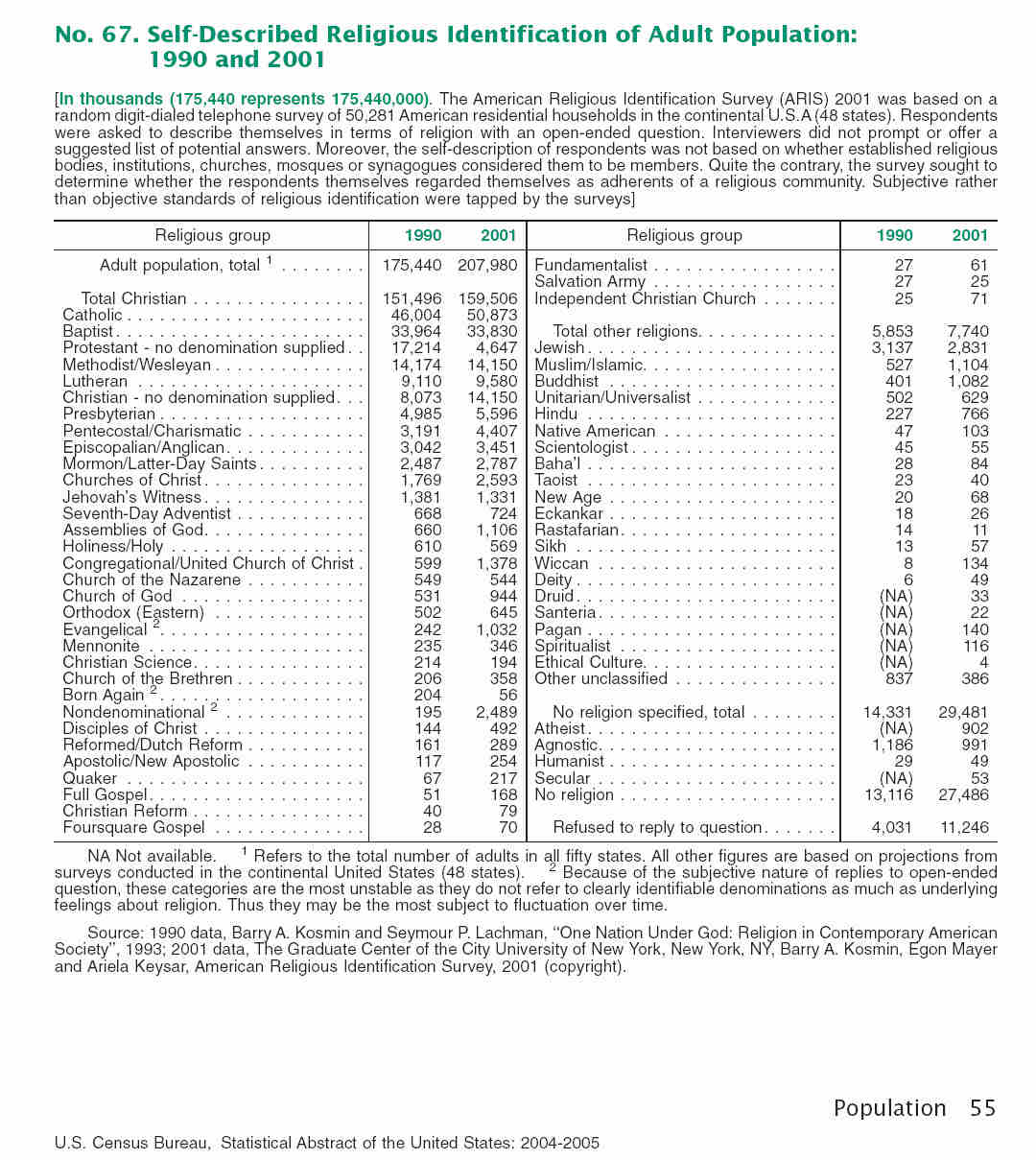
In 2001, the American Religious Identification Survey (ARIS) estimated 55,000 Scientologists in the U.S.

Other, more recent, religious surveys are no better for Scientology. The Pew Forum on Religion and Public Life completed a comprehensive survey based on interviews with more than 35,000 Americans age 18 and older. The findings? Scientology didn't show up in enough numbers to even be mentioned. They noted religious affiliations down to less than 0.3%. This survey found, at the smallest numbers, Wiccan and Pagan -- but below that they stopped specifying.

Since the Church of Scientology has always stated that a majority of it's membership resides in the U.S., this doesn't bode well for totaling eight million world wide.

Indeed, as we look to official census statistics from other parts of the world, the numbers look even worse for Scientology.

The British 2001 Census reported only 1,525 Scientologists in Canada, 282 in New Zealand, and only 1781 in England and Wales.

According to the latest Australian Census, there are only 2508 Scientologists in the whole of Australia.

[EDIT] This just in from Germany: There was a proposal to ban Scientology in Germany. I've always opposed such a ban on the grounds that it gives Miscavige's Church of Scientology too much importance and stature. It turns out the German government thinks the same way. Referring to the prohibition lawsuit, Minister of the Interior Körting said:
The Federal Office for the Protection of the Constitution has come to the insight that Scientology is anticonstitutional, but since Scientology is a small, insignificant organization, with just few members in Germany, the principle of proportionality must be retained. There would probably be no successful Scientology prohibition lawsuit, but the warnings and monitoring against Scientology will continue.
[Thanks to Simon for translating. Emphasis added by me.]
If anyone wants to locate and translate recent religious surveys from other parts of the world, I would appreciate it. However, we can safely assume the results would be quite similar.

Once again, the definitive answer to the question "Where are all the Scientologists?" is, "Gone!" David Miscavige is desperately looking for a different answer, but that isn't working. Reality is what is, not what you pretend it to be. Hint for Miscavige: You can't find Scientologists where there aren't any.

While it is undoubtedly true that the Church of Scientology membership numbers never were as high as they claimed, even during better times when L. Ron Hubbard was running the church, the numbers today are far fewer than many thought, and, from all the evidence, the numbers are still dropping. The latest verifiable figures are from 2001 and things have not gone well for the Church of Scientology since then.

For example, the Shrine Auditorium in Los Angeles, used by the Church of Scientology for some of its big events holds over 6,000 people in the main auditorium. Many years ago the events would fill the main room and they had to provide an "overflow room" for those that couldn't get in. Today, the Church of Scientology can't even fill the main auditorium. As another example, in Clearwater, reportedly the second largest concentration of Scientologists in the U.S. after Los Angeles, they hold their "big event" in Ruth Eckerd Hall, which holds only 2,000 people.

The real answer to the question of how many Scientologists seems to garner a lot of denial from Scientologists, but this isn't opinion and it isn't speculation, this is fact from official sources. At a very generous estimate, Scientology's actual membership is considerably less than 1% of their claimed membership.

Fact are facts. Reality is reality. Of course, the Church of Scientology doesn't associate much with reality.
-